
Gubernatorial Primary Trends
In Bexar County, Texas

This issue of The Béxar Conservative examines Gubernatorial Primary Trends in Béxar County, Texas.
PRIMARY ELECTION: The Primary will be held on Tuesday, 3 March 2026. The first day of early voting is Tuesday, 17 February 2026 and the last day for early voting is Friday, 27 February 2026. If you plan to vote by mail, applications can be submitted starting 1 January 2026 and the last day to apply for a primary ballot by mail is Friday, 20 February 2026.
PRECINCT CONVENTIONS: historically they are held in the evening hours following the closing of the polls. They generally begin at 7:30pm and can last from a few minutes to several. State Senatorial Conventions will be held probably on 28 March 2026. This begins the Republican State Convention Process which culminates in Houston, Texas the week of 8-13 June 2026.
FILING FOR A PLACE ON THE BALLOT, e.g., for precinct chair, opened 9 September 2025 and closed on Monday, 8 December 2025, 6:00pm. If you are filing to run for any office other than precinct chair, e.g., State Representative, you can file between Saturday, 8 November 2025 and Monday, 8 December 2025, 6:00pm (deadline).
TOTAL PARTISAN PRIMARY BALLOTS CAST
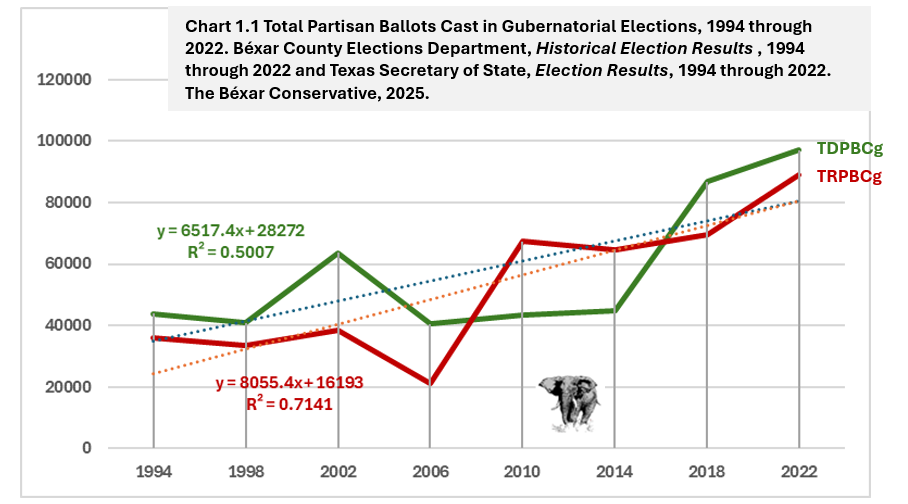
Chart 1.1 shows Total Republican Primary Ballots Cast (TRPBVg) and Total Democrat Primary Ballots Cast (TDPBCg) over the period from 1994 through 2022. Of the 8 primary elections, socialists outperformed republicans in 6 of the 8 (75%). From 1994 through 2006, Republicans consistently underperformed in Béxar County. The Tea Party insurgency manifest itself in 2010 and 2014, outperformed the socialists, but then in 2018 and 2022 Republican performance lagged the socialists. Over this entire period, Texas has had a Republican sitting as Chief Executive Officer - Governor. So, we might be suffering from the “Incumbent effect” as well, that is , fewer people turnout because we have control of state government.
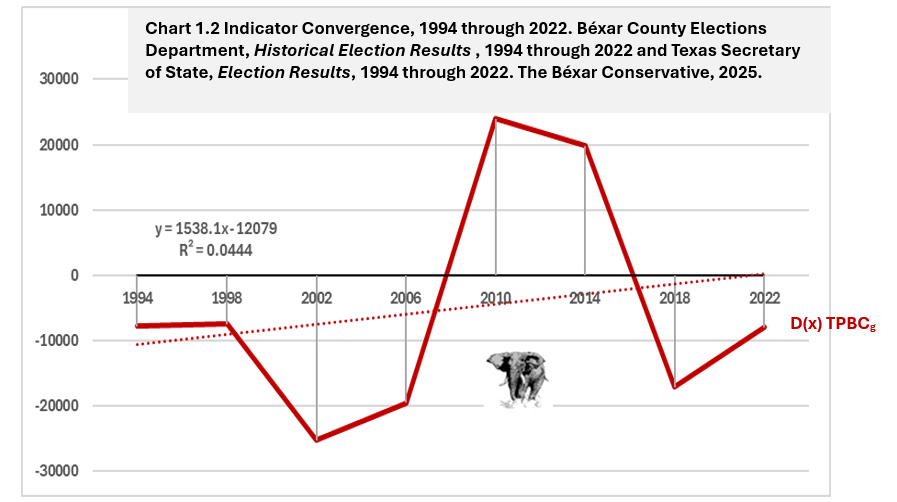
Trend analysis shows both indicators converging overtime. TRPBVg has a higher rate of growth than TDPBCg. Chart 1.2 confirms this convergence. The convergence model essentially has a flat trend showing a slight advantage to Republican Primary voters, growing at 1,538.1 more votes per election.
TOTAL PARTISAN TURNOUT
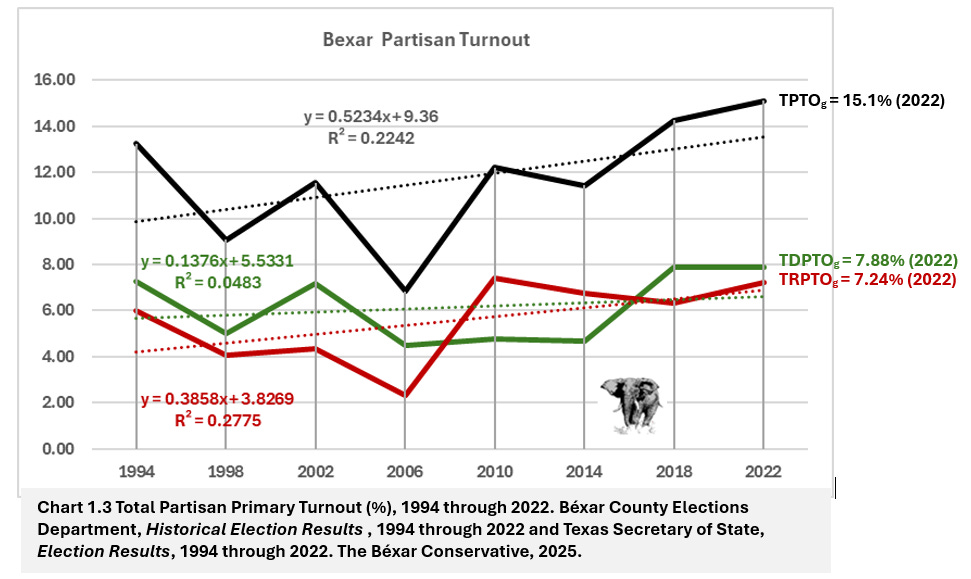
Chart 1.3 shows Total Partisan Turnout. The crimson line equals the Total Republican Primary Turnout (TRPTOg) and the green line equals the Total Democrat Primary Turnout TDPTOg. The data pattern and trend for these two indicators are very similar to partisan primary ballots cast. The historical average TRPTOg = 5.56%. These data show a clear convergence. In 2022, Béxar County experienced a record Primary Turnout of 15.1%.
TOTAL PARTISAN VOTING STRENGTH
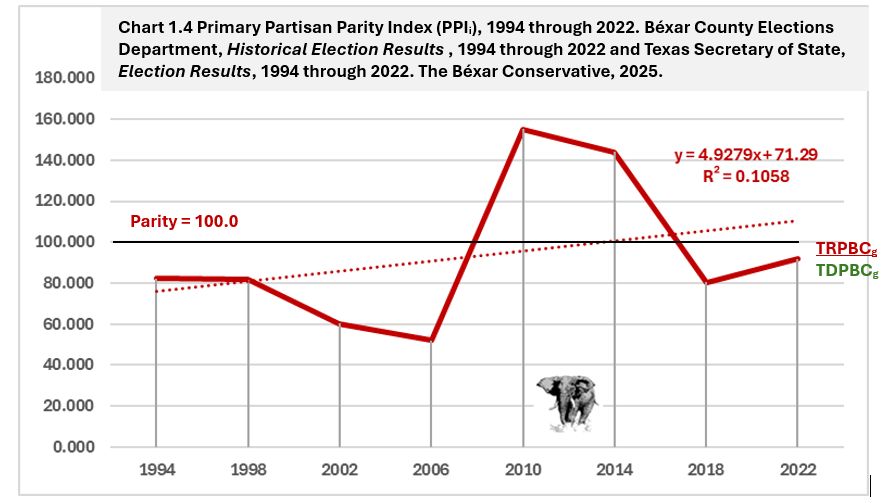
Chart 1.4 shows the Primary Partisan Parity Index (PPIg). The index measures the voting strength of Republicans to Socialists. If the index is > 100.00, Total Republican Primary Ballots Cast (TRPBCg) are greater than TDPBCg. If the index is < 100.00, Total Republican Primary Ballots Cast (TRPBCg) are less than TDPBCg . Republican Primary Voters only outperformed socialists in two primaries, 2010 and 2014, the Tea Party insurgency and the Open Gubernatorial Primary.
THE GUBERNATORIAL PRIMARY MULTIPLIER
Chart 1.5 shows the Gubernatorial Primary Multiplier (PMg). PMg is a ratio of the Total Number of Republican Ballots Cast (TRBCg) in the General (Gubernatorial) Election to the Total Number of Republican Primary Ballots Cast (TRPBCg). PMg peaked in 2006 (≈7.0), while reaching a trough in 2010 (≈2.2). PMg measures how primary participation translates into general election strength (often for a party). The declining trend suggests reduced conversion efficiency — i.e., the gap between primary and general performance has widened or voter alignment between the two stages has weakened.
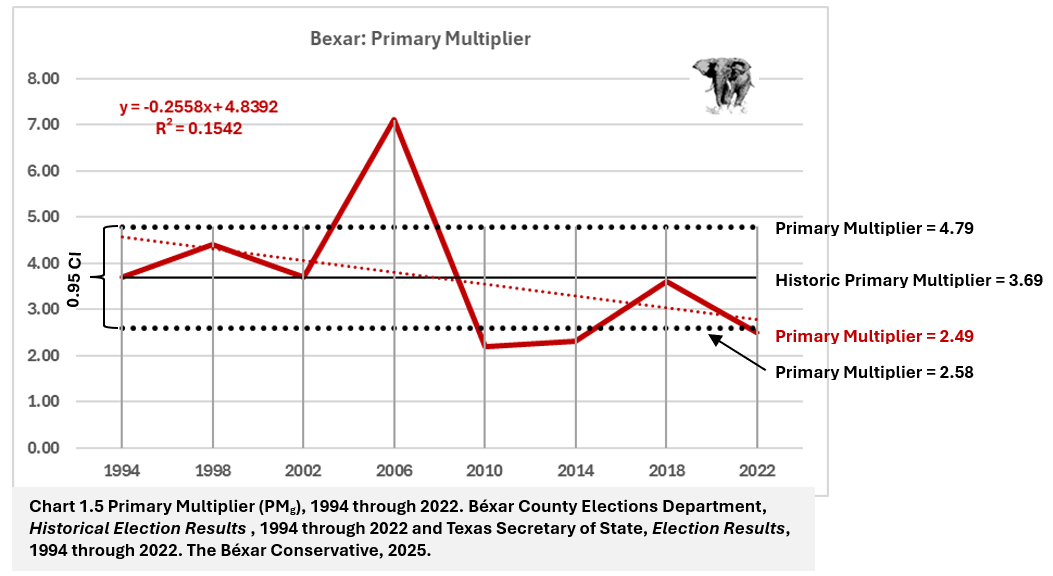
The chart shows the 0.95 CI (Confidence Interval) for the measurement. The historic average for the period equals 3.69, that is, for every 1.0 Republican Primary Ballots Cast (TRPBCg) 3.69 Republican Ballots are cast in the Gubernatorial General Election. However, that historic average has not been reached or exceeded since 2006. In 2022, PM2022 equaled 2.49 and in the post-2006 period the average is just inside the lower limit CI, 2.65. The historic mean (~3.9–4.0) versus the 2022 value (2.49) implies a ~36% reduction in multiplier strength since the mid-1990s.
Trend Analysis: The negative slope (-0.2558) indicates a declining PMg over time. R² value (0.1542) means only about 15% of the variation in the PMg is explained by the passage of time — so while the trend is downward, it’s not statistically strong. Given the low R², the trendline should be seen as indicative, not predictive.
Data volatility (notably 2006 spike) suggests the influence of specific election cycles (e.g., high-profile races, turnout surges, or demographic shifts).
TRBCg versus TRPBCg
In 2006, everyone in Texas ran for governor spurred by celebrity candidates like Kiki Friedman, the cigar smoking poet. In addition to everyone running in the General Election, Republicans suffered from the “incumbent effect” as Rick Perry sought his third term as governor. In both 2018 and 2022, we had the “celebrity communist” Beto run for senate (2018) and governor (2022). His so-called celebrity drew in more voters, mostly for Republican candidates statewide. This upsurge in Republican turnout statewide (2018-2022) was in the Rural Suburban counties of Texas. The “Beto Effect,” however, worked in UrbanGOP Counties, like Béxar.
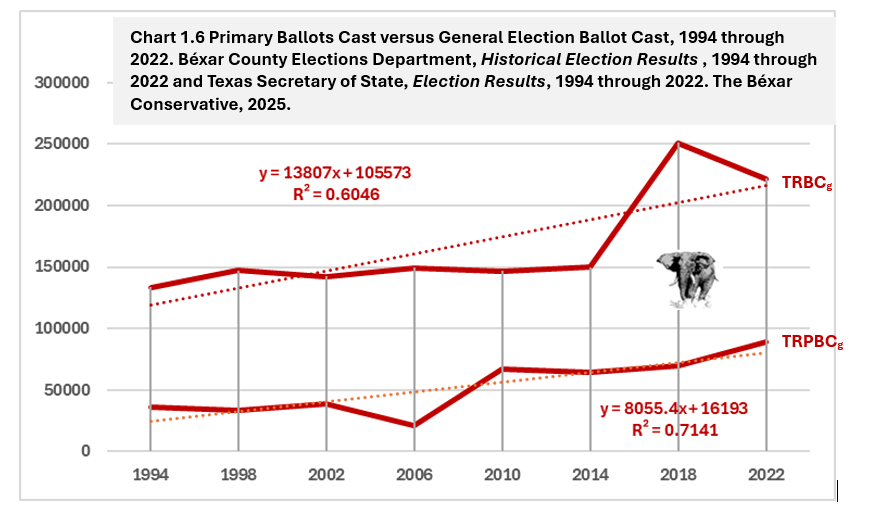
Total Number of Republican Primary Ballots Cast averaged 31.0% of the Total Number of Republican Ballots Cast in the general (gubernatorial) election over the period. The range on this measurement is from 14.1% in 2006 to 45.8% in 2010.
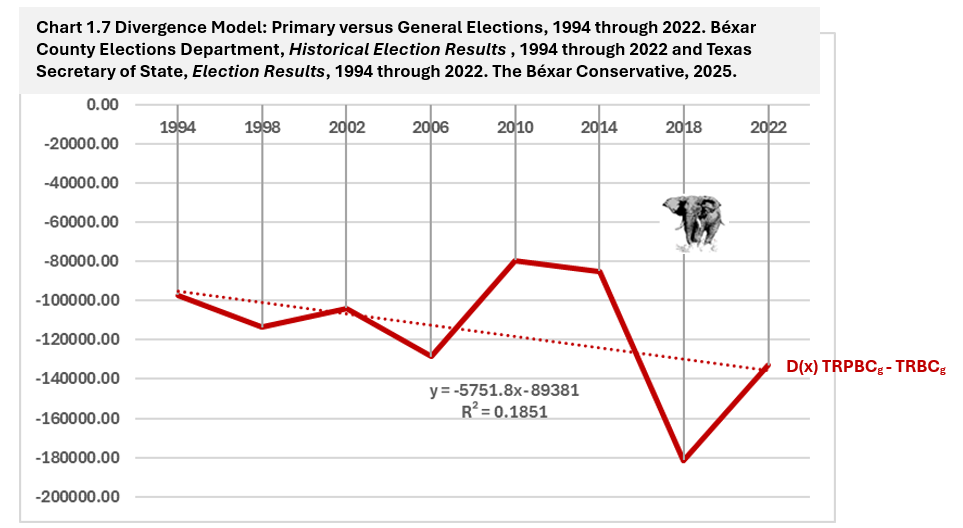
These data also show a growing divergence between the Total Number of Republican Primary Ballots Cast and the Total Number of Republican Ballots Cast in the general (gubernatorial) election over the period. Not only is the conversion efficiency rate declining (see above), but the number of ballots cast in the primary in comparison to the general elections is widening. This gap indicates that fewer voters (percentage) are deciding the nominees, platform, party procedures, and issues, particularly in the convention process. That is, there is far too much UrbanGOP political influence in comparison to Rural – SuburbanGOP political power.
2026 GUBERNATORIAL PRIMARY FORECAST
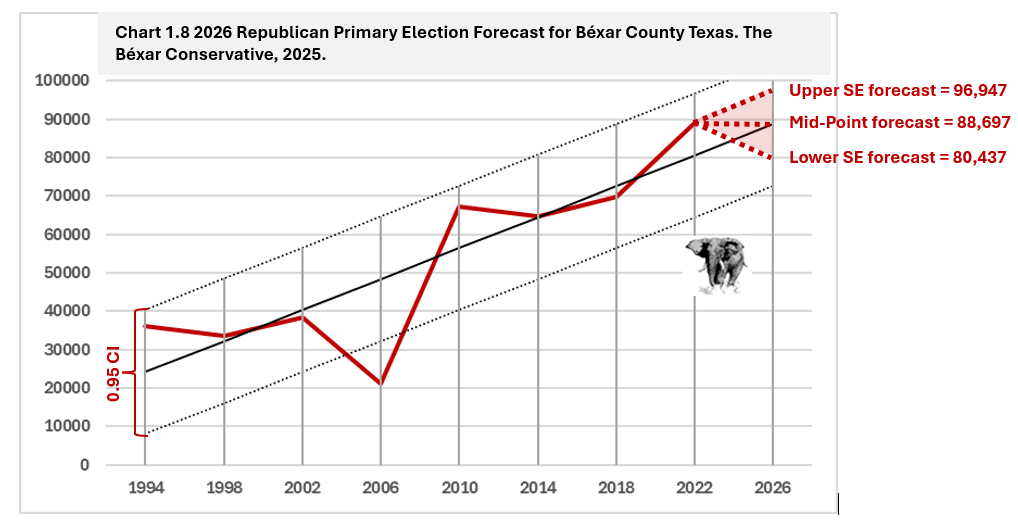
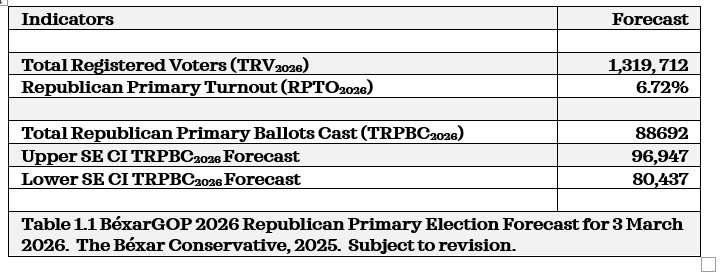
Chart 1.8 and Table 1.1 present The Béxar Conservative’s initial forecast for the 2026 Republican primary election in Béxar County. Outside of the Cornyn – Paxton – Hunt Senate race there are not any real hotly contested races. I would argue that Republican voters should be urging candidates to challenge any Republican member of the house who supported the current speaker and his collaboration with socialists appointing them as chairs or vice chairs of House committees. Those collaborators should be targeted with a MAGA Republican. One would think that given the performance of the State House, there would be a number of these races across the state. But I digress.
At the time of the Republican Primary Election, 3 March 2026, there will be an estimated 1,319,712 registered voters in Béxar County. The Béxar Conservative is forecasting a 6.72% Republican turnout in the Marh Primary.
THE END.